
What Is RTP in iGaming? Return to Player, House Edge and Volatility Explained
RTP is displayed across casino games but frequently misunderstood. Learn how return to player is calculated and how it differs from house edge, hit rate and volatility.
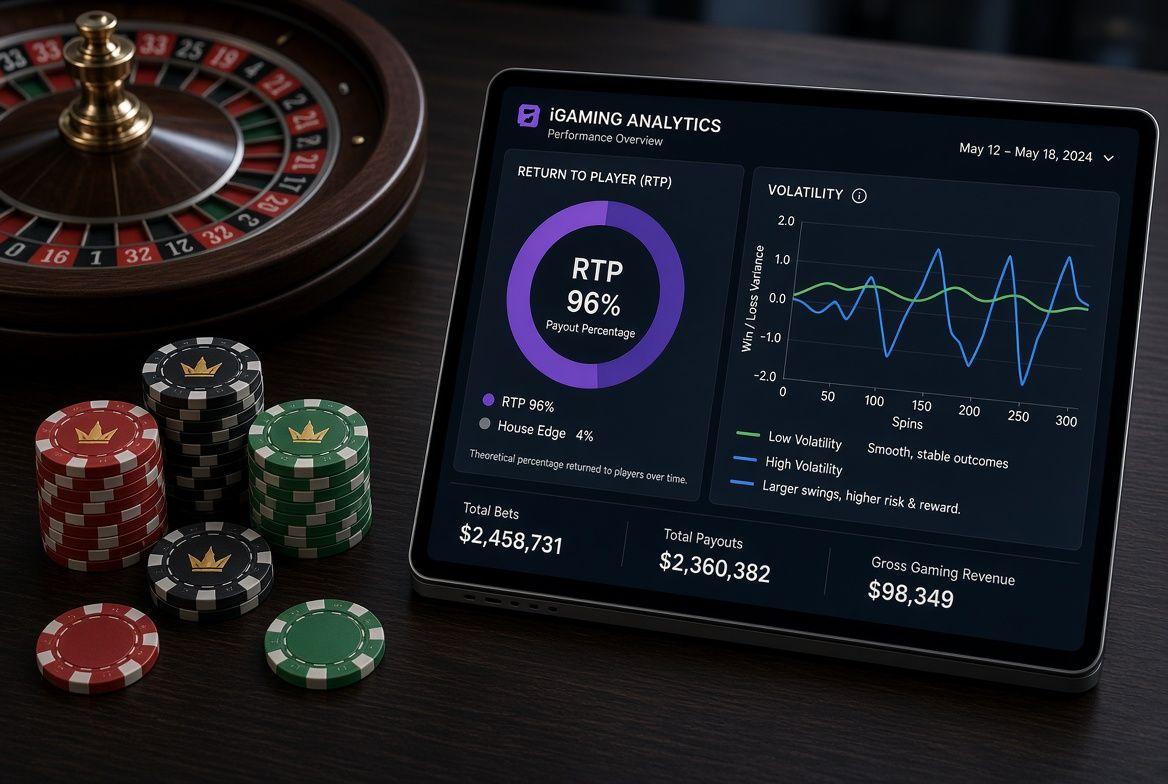
Return to player, usually shortened to RTP, is one of the most widely displayed and widely misunderstood figures in online casino gaming.
An RTP of 96% does not mean that every player receives £96 back after staking £100. It describes the proportion of total stakes a game is mathematically designed to return as prizes over a very large number of plays. An individual session can finish far above or far below that theoretical average.
For operators and suppliers, RTP is more than a marketing statistic. It is part of a game's mathematical design, player-facing information, testing process and live-performance monitoring. It also interacts with volatility, game mix, bonuses and gross gaming revenue.
RTP meaning: the short definition
Return to player is the theoretical or observed percentage of gambling turnover paid back to players as winnings.
If a game has a theoretical RTP of 96%, its mathematical model is designed to return £96 for every £100 staked across the full population of play in the long run. The remaining £4 represents the theoretical house edge before other commercial costs.
That statement contains three important qualifications:
- RTP is calculated across aggregated play, not one player's balance;
- the theoretical figure may require hundreds of thousands or millions of game rounds to emerge closely;
- “returned as prizes” includes winnings that players may stake again.
RTP therefore does not predict the result of the next spin, the next 100 spins or a particular person's evening of play.
The Gambling Commission's consumer explanation of RTP emphasises that the percentage is an average achieved over a significant number of plays.
How is RTP calculated?
There are two related measures: theoretical RTP and actual RTP.
Theoretical RTP
Theoretical RTP is derived from a game's mathematics before it goes live.
For a simplified game with a finite set of possible outcomes, the designer can multiply the probability of each outcome by its payout and add the results:
Theoretical RTP = sum of (probability of outcome × payout for outcome)
Modern slots are considerably more complex. Their calculations can incorporate reel strips, paylines or ways to win, bonus rounds, free spins, multipliers, jackpots and different game states. The principle remains the same: every possible outcome and its probability contributes to the designed return.
Actual RTP
Actual RTP is calculated from real game activity:
Actual RTP = total winnings paid ÷ total stakes × 100
Suppose a game generates £1,200,000 in stakes and pays £1,085,000 in prizes during the measured period:
£1,085,000 ÷ £1,200,000 × 100 = 90.42% actual RTP
The Gambling Commission uses this example in its guidance on calculating RTP. If the game's designed RTP is 91.68%, an observed 90.42% result is below the theoretical figure—but that alone does not establish that the game is faulty. The volume of play and expected statistical tolerance must also be considered.
RTP and house edge
RTP and house edge express opposite sides of the same theoretical relationship.
House edge = 100% − RTP
| Theoretical RTP | Theoretical house edge |
|---|---|
| 99% | 1% |
| 97% | 3% |
| 96% | 4% |
| 94% | 6% |
| 90% | 10% |
A 96% RTP therefore corresponds to a theoretical house edge of 4%.
House edge should not be confused with guaranteed operator profit. An operator's result can vary over any limited period, especially when a high-volatility game pays a large prize. Gaming revenue is also reduced by supplier charges, jackpot contributions, bonuses, payment costs, taxes and other deductions.
For a fuller explanation of the commercial metrics, see GGR vs NGR: Formulas, Deductions and Worked Examples.
A worked RTP and expected-loss example
Imagine 10,000 spins at £1 on a slot with 96% theoretical RTP.
- Total turnover: £10,000
- Theoretical player return: £9,600
- Theoretical house edge: £400
The mathematical expected loss is therefore £400 across that total volume.
This does not mean the first 1,000 spins will return exactly £960 or that each block of play will lose £40. The actual outcome could deviate substantially, particularly on a volatile game. With sufficient rounds, actual RTP is generally expected to move closer to the mathematical figure within an appropriate tolerance.
The same principle applies to a player's expected cost:
Theoretical expected loss = total amount staked × house edge
If total stakes—not deposits—equal £500 on a 96% game, the theoretical expected loss is:
£500 × 4% = £20
A player who deposits £50 can produce turnover considerably above £50 by recycling winnings into further bets. This is one reason deposit value cannot be substituted for stakes when interpreting RTP.
Why a 96% RTP does not mean a player will get 96% back
A common misunderstanding is to apply the percentage to a single session.
A random game does not normally keep track of how much one individual has lost and then make later rounds compensate that player. Each result is generated according to the game's approved design. One player could lose throughout a short session while another wins a large prize after only a few rounds.
The advertised RTP becomes meaningful statistically across a large population of outcomes. According to the Gambling Commission, random games may require very large numbers of cycles—potentially millions—for the averaging effect to become close to the expected percentage.
This is also why statements such as “the machine is due to pay” are misleading. Previous independent random outcomes do not create a debt that the next spin must repay.
RTP is not hit frequency
Hit frequency measures how often a game produces a winning outcome. RTP measures the value returned.
A slot can have a high hit frequency while returning many prizes worth less than the stake. Another can have a lower hit frequency but place more of its theoretical return into occasional large wins.
For example:
- Game A may award small prizes frequently;
- Game B may produce long losing sequences but offer rare, much larger prizes;
- both could have the same 96% theoretical RTP.
Neither the number of winning spins nor the advertised jackpot alone reveals the game's overall return.
RTP is not volatility
Volatility—also called variance in common industry usage—describes how widely and how frequently outcomes tend to differ from the average.
The Gambling Commission describes high-volatility games as having larger statistical tolerances and potentially containing prizes that are very large but rare. Low-volatility games tend to be more predictable, with smaller prizes awarded more frequently.
| Characteristic | Lower volatility | Higher volatility |
|---|---|---|
| Typical prize pattern | Smaller, more frequent wins | Larger, less frequent wins |
| Short-term balance movement | Usually steadier | Often sharper |
| Statistical tolerance | Narrower | Wider |
| Time needed for actual RTP to settle | Potentially shorter | Often longer |
| Theoretical long-run return | Can be identical | Can be identical |
Two games can both advertise 96% RTP and feel entirely different to play because their volatility and prize distribution differ.
For product teams, presenting RTP without accessible information about game mechanics may leave customers with an incomplete understanding of risk.
Can the same slot have different RTP settings?
Yes. A supplier can create more than one certified mathematical configuration of a game. For example, versions might be offered at 96%, 94% and 92% RTP.
An operator or aggregator may select from the configurations made available to it, subject to applicable regulation, certification, contractual arrangements and correct player-facing disclosure. The version live on one casino should not automatically be assumed to match the version offered elsewhere.
This makes accurate configuration management essential across the supply chain:
- the studio creates and tests the mathematical variants;
- the game or aggregation platform maps the correct build;
- the operator selects an approved configuration;
- player-facing rules display the figure for the live version;
- monitoring confirms that the operational game performs within the expected range.
Our guide to casino game aggregators explains how studios, platforms and operators connect within this distribution chain.
RTP in slots, table games and live casino
RTP is used across multiple casino formats, but the calculation and player behaviour differ.
Online slots
Slots usually have a fixed theoretical RTP for the selected certified configuration. Features such as free spins, bonus games and jackpots can all contribute to the total percentage.
A feature may account for a meaningful share of the return. Players who complete only a small number of spins may therefore experience results far removed from the headline figure.
Blackjack and other strategy games
For some table games, the theoretical return depends on the rules and the decisions made by the player. Blackjack RTP is often quoted on the assumption that an appropriate strategy is followed.
Rule variations—including the number of decks, dealer behaviour, blackjack payout and doubling options—change the house edge. A headline percentage without its underlying rules can be misleading.
Roulette
Roulette's house edge follows from the wheel and payout structure. European single-zero roulette generally produces a lower house edge than double-zero American roulette because there is one fewer losing zero outcome for even-money bets.
Different bets on the same standard wheel usually retain the same mathematical house edge, though their volatility can differ.
Live dealer games
Live casino results come from physical equipment and streamed game rounds rather than a conventional software RNG determining every outcome. Operators must still monitor performance and investigate unusual deviations.
The Commission notes that performance measurement for live dealer games may need to account for factors such as game speed, operating hours, table limits and the volume of completed rounds.
Progressive jackpots
Part of the return may fund a progressive prize pool. The realised RTP can depend on the jackpot state and how contributions and prizes operate across linked games or networks.
Operators should distinguish base-game return, jackpot contribution and the conditions used to calculate any advertised combined figure.
Theoretical RTP versus actual RTP
The two figures serve different purposes.
| Measure | What it represents | Primary use |
|---|---|---|
| Theoretical RTP | The return built into the approved mathematical design | Certification, disclosure and performance benchmark |
| Actual RTP | Winnings divided by turnover over a selected live-data period | Monitoring operational performance |
| Expected tolerance | The statistically acceptable range around theoretical RTP | Deciding whether a deviation needs investigation |
Actual RTP can be above or below theoretical RTP without indicating a problem. The key questions are:
- how many rounds or how much turnover has been measured?
- what is the game's volatility?
- what confidence level and tolerance apply?
- were all stakes, prizes and jackpot elements recorded correctly?
- did a release or configuration change occur during the period?
- are different stake levels or versions being combined?
- is a small amount of activity distorting the result?
The Commission's live RTP monitoring guidance suggests that rolling measurement periods can help teams detect newly introduced errors without allowing older activity to conceal them.
Testing and monitoring requirements in Great Britain
Games offered under a Gambling Commission licence must satisfy the applicable Remote Gambling and Software Technical Standards and testing strategy.
Before release, testing can include:
- review of the game mathematics;
- verification of the theoretical RTP;
- assessment of artwork and player-facing rules;
- software implementation testing;
- simulation, emulation and manual testing;
- verification of RNG output mapping;
- checks of scaling, prize tables and game states.
The Commission's testing procedure specifically includes verification of game design, rules, maths and theoretical RTP.
Once a game is live, the responsibility continues. Operators must have processes to monitor ongoing performance and investigate results outside expected tolerances. Licensed businesses also conduct games-testing audits through approved independent test houses.
The broader Remote Gambling and Software Technical Standards cover game information, result determination, random outcomes, interrupted play, jackpots, security and responsible product design.
How RTP should be presented to players
For relevant remote games, information explaining the rules and likelihood of winning must be available before the customer commits to gamble. Content must be accurate and sufficiently clear to explain how the game works.
Good presentation should:
- show the RTP for the version actually offered;
- explain that it is a long-run mathematical average;
- avoid suggesting a guaranteed return for a session;
- make game rules accessible before play;
- state when strategy can affect the theoretical return;
- explain the treatment of jackpots where relevant;
- avoid confusing “chance of a win” with expected value.
This is not merely a wording issue. In August 2026, a Gambling Commission freedom-of-information response noted research indicating that consumers consistently misunderstand RTP and may interpret it as their personal chance of winning or expected session return.
A precise number can create false confidence if its meaning is not explained.
How operators use RTP commercially
RTP influences several parts of an operator's business.
Game portfolio and positioning
Operators may balance game type, theme, volatility, supplier and mathematical configuration across the lobby. RTP can affect customer perception, but it is only one component of product quality.
Revenue forecasting
At scale, theoretical hold contributes to revenue modelling. Finance teams should still account for volatility, jackpot exposure, promotions, player mix and supplier commercials.
Supplier agreements
Commercial terms may be calculated against GGR, NGR, turnover or a combination of measures. The selected RTP configuration affects the economic context in which those charges are incurred.
Bonus economics
Bonus wagering can generate substantial turnover. The interaction between RTP, contribution rates, wagering requirements and excluded games affects both player value and operator liability.
Compliance and incident detection
Live RTP monitoring can identify incorrect configurations, data problems, game faults and unexpected changes following a deployment.
Customer support
Support teams need a clear explanation of why individual play can diverge from theoretical RTP. Telling a player that a 96% game “pays back £96 from every £100” without the long-run qualification is inaccurate.
RTP and operator revenue are not the same thing
If a game has 96% RTP, it can be tempting to describe the operator's margin as exactly 4%. That is only the theoretical game hold against turnover.
The operator's actual financial result also depends on:
- realised game outcomes;
- jackpot contributions and payments;
- bonuses and promotional credits;
- payment-processing costs;
- fraud and chargebacks;
- supplier and platform revenue share;
- affiliate commissions;
- gambling duty;
- safer-gambling and compliance expenditure;
- customer balances and accounting treatment.
This is why RTP is a product metric, while GGR and NGR are broader commercial measures.
It also explains the importance of the player account management platform, which records wallet transactions, bonuses, game activity and other account-level information required to reconcile the customer journey.
Common RTP misconceptions
“A high RTP game is safe”
A higher RTP means a lower theoretical house edge under the stated rules. It does not remove the risk of losing, especially during short or high-volatility play.
“The game must pay when actual RTP is low”
Not to an individual player. An operator may investigate aggregate performance outside tolerance, but random results do not make a future player “due” a win.
“RTP tells me how often I will win”
That is closer to hit frequency, and even hit frequency does not describe the size or profitability of wins.
“A 96% game returns 96% of my deposit”
RTP applies to turnover. The same funds may be staked repeatedly.
“The highest RTP is always the best game”
It provides a mathematical advantage relative to an otherwise comparable lower-RTP game, but rules, volatility, stake, session length and player decisions still matter.
“Actual RTP should equal theoretical RTP every day”
Short-period results can vary. Monitoring must use a statistically meaningful volume and a tolerance appropriate to the game's volatility.
iGamingIndustry view
RTP is valuable precisely because it compresses a complex game model into a comparable percentage. Its simplicity is also its weakness.
For players, it should be understood as a long-term statistical expectation, not a promise. For operators, it is a controlled mathematical specification that must remain accurate through testing, integration, disclosure and live monitoring. For suppliers, it is inseparable from game design, volatility and configuration management.
The strongest approach is to present RTP alongside plain-language context. A percentage without an explanation may satisfy curiosity while failing to create genuine understanding.
In a market placing greater emphasis on informed choice, the industry should treat RTP transparency as more than showing a number in a help screen. It should explain what the number can—and cannot—tell the customer.
RTP describes statistical game performance and does not guarantee individual results. Gambling involves the risk of losing money.