
UKGC Licence Fees Rise in October 2026: What Operators Need to Know
Most Gambling Commission licence fees changed on 1 October 2026. Here is what operators, suppliers and personal licence holders need to check.
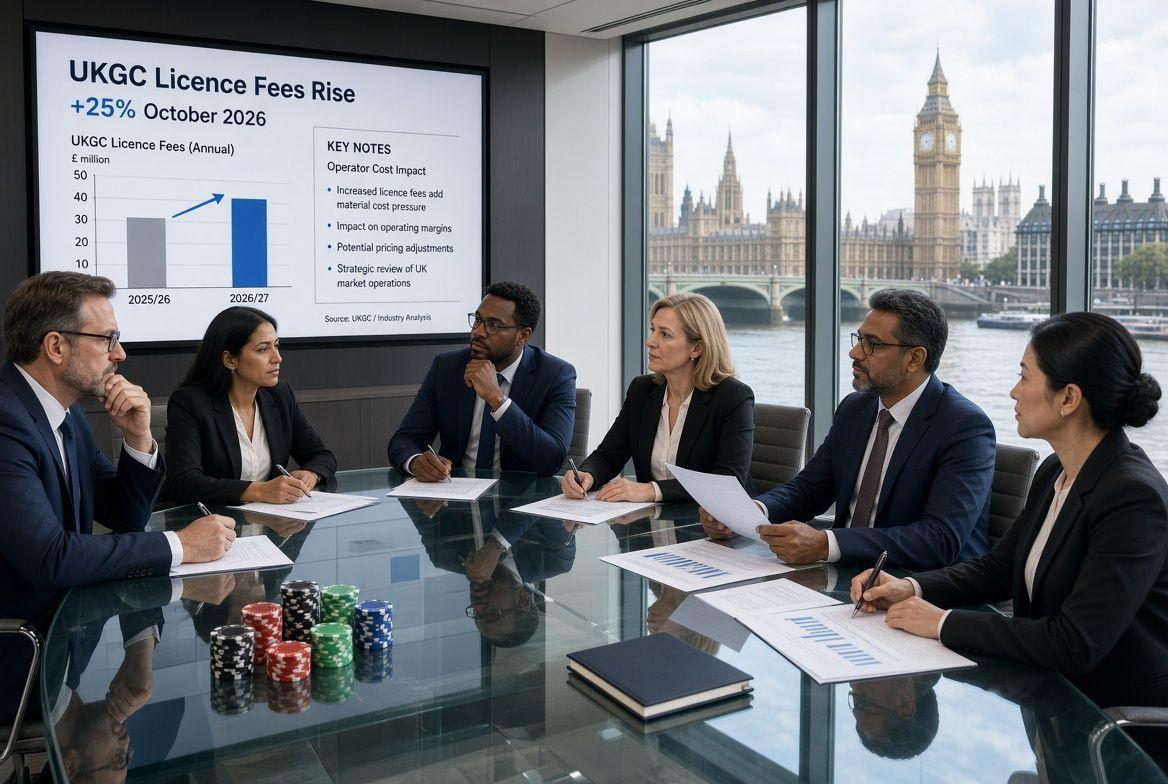
Most Gambling Commission licence fees increased on 1 October 2026, giving operators, suppliers and personal licence holders another cost change to absorb during an unusually expensive period for the British gambling market.
The headline increase is 25%, but it does not apply uniformly to every licence or every operator. The Department for Culture, Media and Sport has also changed the fee structure for several activities, including non-remote general betting, to align charges more closely with gross gambling yield (GGY).
For compliance and finance teams, the practical task is not simply to add 25% to last year's invoice. Businesses need to confirm their activity, fee category, submitted regulatory-return data and renewal date against the Gambling Commission's updated schedules.
What changed on 1 October 2026?
The Gambling (Fees) (Miscellaneous Amendments) Regulations 2026 came into force across England, Wales and Scotland on 1 October.
The main changes are:
- most operating-licence fees increased;
- personal licence fees increased by a flat 25%;
- several application and administrative charges changed;
- fee structures for some activities were revised rather than increased uniformly;
- non-remote general betting fees moved to categories based on annual GGY;
- non-remote 2005 Act casino fees are also based on annual GGY;
- society lottery fees were treated separately and were not subject to the general headline increase;
- the Commission used 2025–26 regulatory-return information when aligning existing operators with revised categories.
The legal basis is set out in The Gambling (Fees) (Miscellaneous Amendments) Regulations 2026. The DCMS consultation response explains how the government reached its final approach.
Does every UKGC fee rise by exactly 25%?
No.
The government selected a broad increase intended to improve the Commission's cost recovery, and personal licence charges rose by a flat 25%. However, the impact on operating-licence holders varies because some activities now use redesigned fee bands.
The phrase “25% fee increase” is therefore a useful summary, not a substitute for checking the applicable schedule.
An operator can experience one of several outcomes:
- the same activity and category with a higher fee;
- transfer into a newly defined GGY band;
- a relatively small increase because of the structure of the revised category;
- in some cases, a lower annual fee after realignment;
- multiple changes where the business holds several licensed activities or linked licences.
The explanatory material accompanying the regulations provides a notable example. For the affected operators discussed in relation to one revised structure, 44% were expected to receive an annual fee reduction and a further 53% an increase of only £22, from £230 to £252. This illustrates why the headline percentage cannot be applied blindly across the market.
Why have fees increased?
The Commission is funded principally through fees paid by licensed businesses rather than from general taxation. DCMS said the changes were required to reflect the regulator's increased costs and allow it to perform its statutory functions.
The January-to-March consultation presented three funding options and received 47 responses, mainly from operators, suppliers and their representatives. The final policy was designed to increase cost recovery while adjusting how regulatory costs are distributed.
The regulatory workload has expanded in several areas:
- supervision of an increasingly digital market;
- enforcement against illegal gambling;
- implementation and evaluation of Gambling Act Review reforms;
- data and technology capability;
- financial and compliance investigations;
- oversight of safer-gambling requirements;
- changes to licence conditions and codes of practice;
- international and cross-border regulatory cooperation.
The Commission's 2026–27 business plan describes the period as the final year of its three-year strategy, Gambling Regulation in a Digital Age.
Whether every part of the increase represents value for money will remain open to industry scrutiny. The immediate legal position, however, is clear: the updated fees are now in effect.
Which iGaming businesses are affected?
The changes extend across a wide range of Gambling Commission permissions. For the online sector, the most relevant can include:
Remote casino operating licences
A remote casino operating licence is required to provide casino games to consumers in Great Britain through a website, mobile device, television or another remote service. This encompasses online slots, roulette, blackjack, poker and other casino products.
Fees are banded primarily by annual GGY. A growing operator may therefore face both an increase in the fee attached to its current category and a category change if its GGY crosses a threshold.
Remote gambling software licences
Businesses that manufacture, supply, install or adapt gambling software through remote communication may require a remote gambling software licence.
This can be relevant to game studios, platform suppliers and certain technology providers even when they do not operate a consumer-facing casino. The precise permission depends on what the business supplies, how the software is delivered and its place in the transaction chain.
For an explanation of how game supply commonly works, see What Is a Casino Game Aggregator?.
Remote betting licences
Sportsbook businesses need the appropriate remote betting permission for the facilities they provide. A company offering betting, casino and virtual products may hold multiple activities, meaning its total regulatory cost cannot be understood from one headline fee.
Game-host and linked licences
B2B providers may operate under game-host or linked arrangements depending on their activities and existing permissions. The Commission publishes separate schedules, including additional charges for certain combinations of host activities.
Personal licences
Personal Management Licence and Personal Functional Licence holders are also affected. Personal licence fees received the flat 25% increase described by DCMS.
Operators should account not only for the company's licence but also for the cost and administration associated with relevant individuals.
Application fee, first annual fee and continuing annual fee
These three costs should not be confused.
| Charge | When it applies | Key point |
|---|---|---|
| Application fee | Submitted with a new licence application | Generally non-refundable and based on the activities and scale requested |
| First annual fee | Normally due after the licence is issued | For many operating licences, it is due within 30 days and may receive a prescribed reduction |
| Continuing annual fee | Payable each year | Based on the applicable activity and fee category at renewal |
For example, the Commission states that the first annual fee for a non-remote general betting standard licence is due 30 days after issue and is reduced by 25%. That first-year reduction is separate from the October 2026 policy increasing or restructuring licence charges.
The safest starting point for a current calculation is the Commission's official operating licence fees calculator.
How the new GGY categories work
Gross gambling yield is generally the amount retained from customers' stakes after winnings are paid, subject to the statutory definition applying to the relevant activity. It is a measure of gambling activity rather than company profit.
Fee bands use GGY because the government and regulator regard the volume of gambling as a key indicator of regulatory workload and risk. Larger businesses typically generate more customer activity, data, compliance interactions and potential consumer impact.
This does not mean that GGY reflects an operator's ability to pay perfectly. It does not deduct all technology, marketing, staffing, payment, game-supplier and compliance expenses.
Our guide to GGR vs NGR explains the commercial distinction between top-line gaming revenue and the deductions that lead towards net gaming revenue.
Example of a category change
The revised non-remote general betting standard schedule includes categories beginning with:
| Category | Annual GGY range | Application fee |
|---|---|---|
| A1 | Less than £250,000 | £1,351 |
| A2 | £250,000 to below £875,000 | £1,764 |
| A3 | £875,000 to below £3 million | £2,303 |
| B1 | £3 million to below £10.5 million | £3,108 |
Higher categories continue above these thresholds. These figures illustrate the application-fee structure for that specific activity as at October 2026; they should not be treated as the fee table for remote casino, software or other permissions.
Operators must use the schedule matching their actual licence activity.
Why regulatory returns now matter even more
The Commission indicated that submitted regulatory-return data for 2025–26 would be used to place existing operators into relevant revised categories.
That gives finance and compliance teams a shared responsibility. A reporting error can affect more than regulatory data quality; it may also contribute to an incorrect fee classification.
Businesses should verify:
- the GGY reported for every licensed activity;
- whether figures cover the required reporting period;
- allocations where revenue spans remote and non-remote channels;
- treatment of white-label or B2B arrangements;
- consistency between returns, management accounts and audited information;
- whether growth forecasts indicate that a higher category will soon be required.
The Commission's regulatory returns guidance remains the primary reference for the information collected by licensing sector.
What happens if an operator enters the wrong category?
Licence holders are responsible for ensuring their category remains appropriate. If the scale of activity increases, an operator may need to apply for a category change rather than wait for the next routine billing cycle.
The Commission allows fee-category changes through eServices. Moving up one level generally requires less supporting material than an increase of two or more categories. Larger changes can require updated financial projections, a new or revised business plan and evidence showing how the expansion is funded.
A downward change requires a full explanation.
The Commission currently lists a £50 charge for a fee-category change. Adding a new licensed activity is different: it can attract a charge based on 25% of the standard application fee for that activity. These figures and procedures should be checked against the current operating-licence variation guidance before an application is made.
The increase is part of a much larger cost reset
For most operators, the licence-fee increase is not the largest change to their cost base. Its significance comes from arriving alongside several other measures.
Remote Gaming Duty increased from 21% to 40% for accounting periods beginning on or after 1 April 2026. A 25% remote betting rate within General Betting Duty is scheduled for April 2027, subject to its defined exclusions. Operators also face the statutory gambling levy, evolving consumer-protection requirements, technology investment and higher general business costs.
Land-based groups are meanwhile preparing for the possibility of another change to Machine Games Duty. Our analysis, What a 40% Machine Games Duty Could Mean for Operators, examines that proposal and the competing revenue and closure forecasts.
Taken separately, the licence increase may appear manageable for many established groups. Taken together, these measures raise barriers to entry and make regulatory scale more valuable.
Implications for smaller operators and suppliers
A percentage increase creates a smaller cash movement at the bottom of a fee schedule than at the top. Smaller businesses can nevertheless feel the impact more acutely because compliance costs are spread over less revenue.
A new entrant may need to fund:
- a non-refundable application fee;
- legal and licensing advice;
- policies and risk assessments;
- technical testing and security work;
- key personnel and personal licences;
- AML and safer-gambling systems;
- data protection and payments infrastructure;
- annual fees before the operation reaches scale.
This can favour established platforms, white-label structures and service providers capable of distributing compliance expenditure across several brands. It can also increase due-diligence pressure: outsourcing technology or operating under a wider platform does not remove the need to understand which entity holds each regulatory responsibility.
Our white-label casino guide explains the commercial model and the distinction between brand ownership, platform provision and regulatory accountability.
A practical checklist for licence holders
For the full application workflow, supporting documents and suitability assessment, see How to Get a UK Gambling Licence.
Following the 1 October change, operators and suppliers should:
- Confirm every licensed activity. Check the public register and internal licence schedule.
- Review the new category. Do not assume the previous band carried over unchanged.
- Reconcile regulatory-return data. Confirm the 2025–26 figures used for classification.
- Run the official calculator. Model application, first-year and recurring costs separately.
- Check renewal dates and cash flow. The policy effective date does not mean every annual invoice falls on 1 October.
- Review personal licences. Include current holders and expected appointments.
- Model growth thresholds. Identify when projected GGY would move an activity into a higher band.
- Document category decisions. Keep the calculations and evidence supporting the selected band.
- Assess the whole regulatory cost base. Include tax, levy, testing, compliance staff and external advice.
- Take advice where the activity is unclear. Software, hosting and multi-product structures can create licensing questions that a generic fee table cannot resolve.
iGamingIndustry view
The October increase is more nuanced than the headline suggests.
Most of the sector will pay more, and the regulator has secured additional resources at a time of expanding responsibilities. Yet redesigned categories mean the effect varies significantly between licence types and operators. Some businesses may pay less, while others face a substantial increase because of both the new rates and their position within a GGY band.
The larger strategic point is that Great Britain is becoming a more expensive market in which to launch and operate. Licence fees alone are unlikely to determine whether a serious operator enters the market, but they contribute to a cumulative cost that rewards capital, compliance maturity and scale.
Businesses should therefore treat the 1 October changes as more than an accounts-payable update. They are a reason to verify revenue reporting, licence scope and the economic assumptions supporting every regulated activity.
This article reflects Gambling Commission and government information available on 15 October 2026. Fees should always be confirmed using the current official schedule before an application or renewal.
Related
More coverage

UK Gambling Tax Battle: What a 40% Machine Games Duty Could Mean for Operators
The Treasury is considering a sharp increase in Machine Games Duty. We examine the competing revenue and closure forecasts—and the implications for retail and online operators.
15 Oct 2026

UK Gambling Affiliate Compliance: Advertising Rules and Operator Responsibilities
A sourced guide to gambling affiliate advertising, operator oversight, significant offer conditions, under-18 protection and current bonus rules.
4 Oct 2026